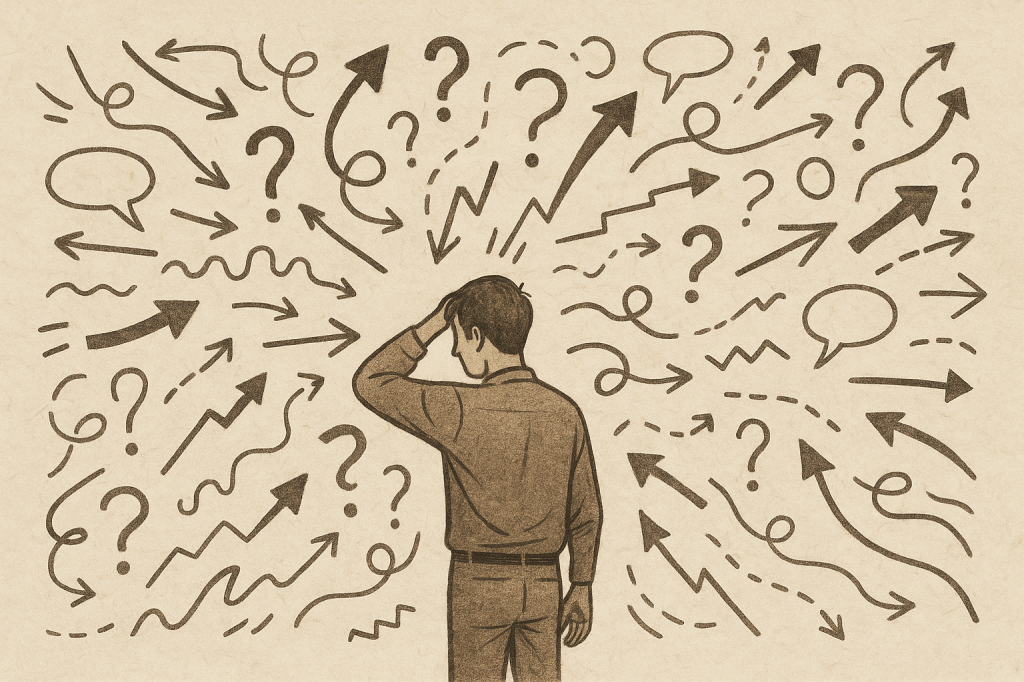
Introduction: Why Truth Still Matters
Why does the question “What is truth?” even matter anymore?
The concept of truth still matters because as a society, we are faltering. Morality is no longer seen as a compass, but as a nuisance. Instead of viewing truth as a guide for becoming someone good or better, most now see it as a limiter to personal freedom. Most people lean toward choices that are self-serving or destructive, and defend those choices as their freedom of expression and choice. In today’s world, morality is treated as restrictive, not redemptive. But when morality becomes optional, we don’t just lose virtue, we can lose direction.
What are the stakes of getting this wrong, in our own lives, in society, and in how we form meaning?
The stakes of not taking truth seriously in our personal lives are enormous. We can become someone that we don’t want to become. If we believe in God, we can drift from Him, not because He moved, but because we stopped becoming like Him. God does not conform to us. He calls us into alignment with Himself. If we believe in spirituality, we may confuse emotional highs or mystical moments with real growth. Truth keeps us anchored. Without it, we chase illusions.
In society, the loss of truth as a shared foundation leads to chaos becoming the only thing left to bind us. And when we lose truth as our source for meaning, we don’t stop seeking that meaning, we just settle for lesser types or kinds of meaning. We find identity in trends, outrage, or tribal belonging. We mistake cultural relevance for purpose. But meaning built on popularity or groupthink is fragile. It shifts and it fails, while truth doesn’t.
What is commonly mistaken for truth today, and why do those substitutes fail?
Many things are mistaken for truth in our culture, feelings, personal experience, group consensus, even usefulness. We often say “this is my truth” when we really mean “this is what I’ve felt.” But something can be true to your experience without being truth itself. That’s the confusion. We’ve collapsed internal perception with objective reality. People now treat their lived experience as untouchable, as if being sincere means being right. But feelings change. Consensus shifts. What works for one person might destroy another.
Truth isn’t defined by emotion, popularity, or results. It isn’t something we create or customize. It is defined by what is, regardless of whether it’s recognized, agreed with, or liked. Real truth does not orbit around us, it stands apart and it holds true.
The Nature of Truth: Objective or Subjective
Is truth something that exists independently of our beliefs, or is it shaped by them?
Truth exists independently of belief. There are universal truths that do not adjust to our preferences or understanding. They stand on their own. They demand alignment. They will not shift to meet us. But at the same time, our ability to recognize and follow truth is shaped by belief, by experience, and by bias. Some truths we only see when we are ready. And once we see them, we are accountable to them, but we cannot expect others to live by a truth they have not yet understood. The danger is that our beliefs can also blind us. We do not just approach truth through our experiences, we often defend our experience against truth. That is where belief stops being a bridge and becomes a barrier.
What is the difference between objective truth (what is) and subjective experience (what is perceived)?
Objective truth does not shift. It operates with or without our agreement. Gravity will pull you down regardless of how you feel. Moral law will correct you whether or not you acknowledge it. These truths exist apart from opinion and demand alignment. They must be found, received, and submitted to in order for us to live aligned, whole, and transformed.
Subjective experience, by contrast, is what we perceive. It is how we interpret the world based on our story, pain, culture, and lens. It is a double-edged sword. On one hand, it can humanize truth, giving it form and texture beyond rigid obedience. It is what makes someone not just a biological father, but a true one. Engaged. Sacrificial. Present. On the other hand, subjective experience can also blind us. Bias, tradition, trauma, and dogma can form a version of truth that feels right but fractures reality.
Subjective experience matters. But it is not the measure. Truth is.
Can truth feel different to different people while still being constant underneath?
Yes. Personal experience can shape how people see truth and how they rank its importance. Some treat certain truths as absolute and non-negotiable, while others treat those same truths as flexible or optional, more like a guide than a law. But that does not mean truth itself has changed. It means our perception of it has.
That is why it is essential to recognize how our experiences, traditions, and internal bias shape what we are able to see. The goal is not to dismiss experience, but to interrogate it. If we do not, we risk mistaking our perception for reality, and we cannot align with a truth we refuse to see clearly.
How can we begin to separate what is true from what just feels true?
There is no shortcut to this. The only way to begin separating real truth from what simply feels true is through exposure, through time, challenge, and disciplined seeking. That means reading widely. Listening to opposing views. Testing your assumptions. Talking to people who see the world differently, not to win an argument, but to see where your own lens might be distorted.
Experience is the scalpel. It either deepens our illusions or shatters them, but only if we are willing to explore and then pay attention. The search for truth demands we hold both conviction and openness at the same time.
A helpful starting point is our exploration of The Four Realms of Truth. It offers a framework for our search for truth, and where we can start.
Can Something Be True for Me but Not for You?
Where does the idea that “everyone has their own truth” come from, and why is it so common today?
It is true that everyone has different experiences, different lessons, and different paths. In that sense, people do arrive at different understandings of what feels true to them. But the phrase “everyone has their own truth” can mean very different things depending on the spirit behind it.
If it is said with humility, as a reflection of where someone currently stands, a marker of their lived experience paired with openness to learn, then it can create space for compassion and understanding. It acknowledges that people are on different timelines, and that we cannot demand alignment with a truth someone has not yet seen clearly.
But when it becomes a defense mechanism, when it is used to shut down disagreement, ignore correction, or justify choices without reflection, then it stops being a bridge and becomes a barrier. The idea that everyone has their own truth becomes dangerous when it is no longer a description of current perspective but a declaration of permanent resistance.
In what areas of life is personal perspective legitimate?
In all honesty, personal perspective is legitimate across the board. Emotions, memory, and interpretation, these are part of being human, and they should not be dismissed. What matters is not whether people have personal beliefs, but whether they try to universalize those beliefs to everyone around them, without grounding them in something deeper.
Personal beliefs become dangerous when they are elevated to the level of universal truth without scrutiny. That kind of thinking only holds when applied to undeniable, overarching truths, usually found in the natural realm. Gravity is not up for debate. Biology has structure. These truths operate whether or not we agree with them.
Spiritual truth, on the other hand, is much more nuanced. What feels deeply true to me today could, in time, be revealed as incomplete or even false. That does not mean spiritual experience is invalid. It means we must approach it with humility, not entitlement.
Where does the idea that truth is personal or relative fall apart, especially when applied to moral, physical, or existential claims?
Truth exists on a kind of spectrum, from undeniable on one end to completely unfounded on the other. Natural and biological laws sit on the far end of what is undeniable. Gravity, thermodynamics, anatomy are not up for debate. They function independently of culture, belief, or opinion.
But as we move toward existential and spiritual claims, things become more complex. These truths may be just as real, but they do not come with the same kind of physical evidence or universal agreement. That does not mean they are false. It means they require discernment, not just observation.
In the moral realm, this tension becomes even more obvious. We step into moral wrongness the moment we alter someone’s life without their consent. When we take away another person’s agency, we are no longer operating from personal conviction. We are imposing control. The idea that truth is purely personal collapses the moment it infringes on another person’s freedom to live, choose, or believe. At that point, truth must be tested against something higher than experience. It must answer to justice.
When does “my truth” become a lie?
“My truth” becomes a lie the moment it becomes part of our identity. In the moment, we need conviction. We need to believe what we believe and live like it matters. Without that, we are ungrounded, always questioning, never moving. But over time, if we stop examining what we believe, if we wrap it into our identity and refuse to challenge it, we cross a line.
What was once honest becomes defensive. What was once a marker of growth becomes a justification for staying stuck. Truth requires both firmness and flexibility, conviction in the present and a willingness to reexamine over the long run. When “my truth” becomes something I protect more than I refine, it is no longer truth. It is comfort dressed up as integrity.
Layers of Reality: Is Truth One Thing or Many?
Are there different kinds or realms of truth or is truth always one unified thing?
There are four realms of truth: natural, rational, moral, and spiritual. Each one shows up in a different way and each demands something different from us. Some are rigid and universal. Some are more personal and slow to reveal. But all four are real. And all four matter.
Most people pick the one or two that come easiest and ignore the rest. But that kind of half-alignment always comes with a cost. If you want to be whole you have to pursue truth in all its forms.
How can physical truth like gravity differ from moral truth like justice and still be part of the same structure?
Different types of truth differ in how they show up, how immediate the consequences are, and how rigid they are. Physical truth is clear and fast. You violate it, you see the cost. Moral or spiritual truth might take longer but the consequences still come.
What they share is structure. They all govern how we live, who we become, and how aligned we are with what is real. Some truths show up in the body, some in the mind, some in the soul, but they all pull us toward or away from becoming someone whole.
What happens when people fixate on one kind of truth while ignoring the others?
It is easy to fixate on one type of truth. But doing that always carries a cost. Someone can obsess over financial truth, what works, what builds wealth, and end up morally hollow. Another person can fixate on spiritual truth and ignore physical or logical truth, living detached from reality.
Each type of truth holds weight, but their importance shifts depending on your stage of life, your responsibilities, and what you are facing. That is a complex equation. Even so, there are certain truths that can never be compromised. The ones that keep us safe. The ones that preserve relationships. The ones that shape who we become. When we trade those for what feels urgent, we lose the very things we think we are protecting.
Truth and Belief: Is Believing Something Strongly Enough to Make It Real?
Does sincerity make something true, or just deeply held?
No. Sincerity does not make something true. A mother can sincerely believe she is helping her child by removing every obstacle. But what she is actually doing is stunting their growth and weakening their character.
The same pattern shows up everywhere. We confuse good intentions with right actions. But truth is not based on motive. It is based on outcome. What you meant doesn’t matter if what you caused was damage.
Why do we confuse emotional conviction with reality?
Because of how the brain works. Information hits the emotional part of the brain first. Only after that does it move into rational processing. But for most people, it never makes it that far. It gets stuck in feeling. And once we feel something deeply, we assume it must be true. That’s the trap. Emotion becomes the lens, not the warning light.
We all fall into this to different degrees. That’s why the ability to challenge our own thoughts is not optional. It’s a muscle. And if we don’t use it, our emotions will run the show.
What does it take to test whether a belief is actually true?
You have to train for it. Over time, your brain can learn to challenge beliefs automatically, but it doesn’t start there. You have to start small.
One of the best ways is to write your belief down, then list the opposite beliefs next to it. Try to prove them right. Force yourself to look from the other side. You might still land where you started, but now you’ve tested it. That kind of honesty keeps you from building a life on unexamined assumptions.
How do we honor personal meaning without confusing it with universal truth?
Personal meaning is what shapes who we are. It gives our life direction. We should stay loyal to it. But we have to remember that not everyone shares the same meaning, and not all meaning is universal. Just because something matters deeply to you doesn’t mean it’s binding for everyone else.
As long as someone isn’t crossing moral lines or violating others, it is not your place to impose your meaning on them. Ironically, trying to force your own meaning onto others is where you step into being morally wrong.
What happens when belief becomes a shield against correction?
This is where things get dangerous. When beliefs go unchecked and thoughts go unexamined, people start to think they can’t be wrong. That mindset is how cults form. It’s how dictators rise.
When individuals or groups stop testing their beliefs, they lose the ability to self-correct. History is full of examples. Millions have died because people clung to beliefs they refused to question.
Beyond Belief: Living what You Claim
What’s the difference between agreeing with the truth and actually aligning with it?
You can agree with something without actually aligning with it. Agreement is just verbal. It is saying the right thing. Alignment is different. It means the truth becomes part of who you are. It shapes how you think and how you live. You can agree that good parenting means showing up, and still miss every game. Agreement is a statement. Alignment is a shift.
How do you know if your life is aligned with what is real?
Living out of alignment with truth is living in delusion. The problem is, delusion does not feel like delusion when you are in it. And the truth is, everyone is delusional to some degree. The only way to check is to test. You talk to people who think differently. You measure your beliefs against experts. You put your ideas out into the world and see what holds up. Alignment is not a feeling. It is something revealed through experience, correction, and challenge.
What are the most common ways people betray truth for convenience, safety, or ego?
People betray truth more often than they realize. Sometimes it is for comfort. It is easier to keep doing what you have always done than to question it. Sometimes it is for safety. The beliefs we hold often feel tied to our identity or relationships. Letting go can feel like risking everything. Sometimes it is for ego. Admitting you are wrong costs pride. But that is the point. Truth does not comfort your ego. It confronts it. And the only ones actually on the path are the ones who know they are wrong and keep searching anyway.
What are the subtle ways people convince themselves they are aligned with truth when they are actually avoiding it?
Truth is not always rejected outright. It is often avoided quietly through tradition, distraction, or fear. Many people follow patterns that feel normal but not because they have tested them. They inherited them. What they wear, who they spend time with, what they believe. None of it may reflect what is actually true or right. It just requires the least effort to maintain. In religion, this looks like dogma. Believing something only because it has always been taught. Not because it has been questioned and found to hold up. That is not truth-seeking. That is tradition-preserving. Safety plays a role too. People cling to familiar beliefs not because they are accurate, but because they are safe. Letting go of long-held ideas can risk your comfort, your community, even your sense of self. So people stay confined. They stop looking. Then there is ego. Admitting you are wrong feels like failure. But it is actually how you begin to grow. If you are wrong about something as small as a traffic inconvenience, what else might you be wrong about? In your relationships. In your purpose. In how you treat people. That is not meant to shame. It is meant to wake you up. The only way forward is to keep testing what you think you know. Not to feel safe, but to become whole.
The Cost of Choosing Truth
Why does choosing truth often require suffering or loss?
Choosing truth includes a loss every time you don’t already own that truth. Because to accept something new, you have to let go of what you believed before. A person might believe they’re a good listener, only to find out that they constantly interrupt or dismiss others. That truth forces them to see themselves for what they actually are, not great at listening. It confronts false self-belief, and it changes behavior. Sometimes, truth doesn’t just cause loss, but suffering. A spouse might trust their partner and see them as loyal, only to find out they’ve been cheating. The belief that their partner was trustworthy has to die. That’s what truth does, it forces you to see the world as it actually is. To do otherwise is to live in delusion. And sometimes what you see brings suffering. Especially when it involves the people you’ve built your life around.
Why should we keep choosing truth, even when it costs us?
When new truths are found, so are new opportunities. If we discover we’re actually bad at listening, we can change that. The same goes for how we treat others, how we see ourselves, and how we move through the world. Growth only happens when truth exposes something we didn’t see before. If we’re not open to new truth, we don’t just avoid pain, we avoid change. And if we avoid change, we stay stagnant. We become someone we never intended to be.
Who has lived this out, and what do we learn from their example?
We see examples of this everywhere. In professional sports, the athlete learns from failure. They review film, take coaching, make adjustments. Sometimes they even realize that something they thought they were doing well can be done better with just a small shift. Without that willingness to receive correction, they would never perform at a professional level. The same is true for someone recovering from addiction. Accepting the fact that they have lost control can affect their ego and cause them to lose relationships. But accepting that truth is the only way to heal. We see this in parents who grew up in abusive homes and choose to raise their kids differently. It requires them to face the harsh truths from their childhood and purposefully break old habits and patterns. Even changes to our health follow the same pattern. We must confront the hard truth that we are not doing what is necessary to take care of our health, which may require the loss of some of our favorite foods and activities. But these changes will pave the path to a healthier life. It is hard to invite, consider, and accept new truths. Doing so can bring pain, suffering, and discomfort. But in the long run, we will be much better off for it.
How the False Self Blocks Truth
What is the false self?
One’s ‘self’ is defined by how you perceive yourself, the world and people around you, and your place in it. It shapes your choices, your relationships, and your entire way of living. A false self is built when that perception is off—when your view of yourself, others, or reality is shrouded by false beliefs. We can be taught these false beliefs, or we can learn them through experience. Either way, they become more and more solidified if we don’t challenge them often.
Everyone builds a false self to some degree. No one is fully honest or perfectly aware of how they actually show up. That’s why truth matters. The only way to push back against the false self is to question the beliefs we’ve built our life around—even the ones that seem right. There is always more information and other points of view to consider that may be more true than the ones we own.
How does the false self interfere with choosing truth?
The false self easily gets in the way of our ability to seek and choose truth. At its core, a false self encourages us to believe that we don’t even need to search beyond what we already have, how we already perceive ourselves and the world around us. If we ignore that and seek additional truth, a false self will give us a tinted lens. And in the moment we find additional or contradictory beliefs, a false self will shed doubt on anything we find. So it affects our search for truth in three ways.
How do we dismantle the false self?
The two most effective ways to dismantle the false self are, first, asking a trusted third party for their thoughts and views. And second, searching incessantly, especially through books, videos, and other material made by people with different thoughts and views.
Facing Alternative Frameworks: What Else Claims to Be True?
What are the main competing ideas about truth today?
Relativism claims that truth is different for each individual. Your truth can be different than mine, and both are equally respected as true. Many people like this point of view because it makes space for personal experience. Also, in this theory, no one is wrong. The problem is, this can lead to chaos, as society does not have a shared, objective barometer to live by. So there would be no consistency in justice, lies, etc.
Postmodernism claims that truth is always shaped by our environment, culture, and other outside influences. It’s impossible to get to an objective truth, because there are always filters and exceptions to the rule. Many people like this point of view because it shows the effect of bias on our view of truth. The downside of this view is if we look at truth as being a product of perspective, then there can be no claims of underlying truth that exists despite differing points of view. This would make morality and ethics impossible to determine.
Materialism claims that truth is only that which can be proven through observation and science. Basically, if it cannot be seen or touched, it isn’t truth. What’s nice about this point of view is that it is very black and white. It’s real, it’s truth, or it is not. The downside is that it takes human experience out of the equation, which cannot happen when it comes to exploring spirituality, morality, and similar areas.
How does our framework address the same questions better?
Our framework revolves around the idea that we are ultimately responsible for two things in this life: 1) what we currently know to be true, and 2) our constant pursuit of truth. This stance requires us to have full fidelity to what we know to be true, while also having the humility to know that we could be wrong, and we’ll need to adjust.
What this does is give us the freedom to act fully in the present, without fear. It also gives us meaning, as we know that we have never truly arrived.
Final Reflection
Why does the search for truth never end?
The search for truth never ends because we never fully arrive. What’s nice we know with absolute certainty now, may be a thing of the past a decade from now. We live in an imperfect, experience-filled world that changes us more than we change it. We must accept this, that we never arrive, as it is the foundation that will keep us plowing forward.
What practical steps can a person take to keep choosing truth?
Step 1: Identify the different types of truth. We’ve mentioned four realms, there could be more.
Step 2: Identify material, videos, books, articles, etc., in each of these realms and study.
Step 3: Share what you learn through writing and talking.
Step 4: Rinse, repeat, and enjoy.
What does it look like to live this out daily?
Every day is different, but be sure to be doing one of these things every day and you’ll be just fine in your search. Remember, you’re moving forward or backward when it comes to your search for truth, so keep moving forward. Do something small every day.

 Our Search For Truth
Leave a comment